
The Building Code Man
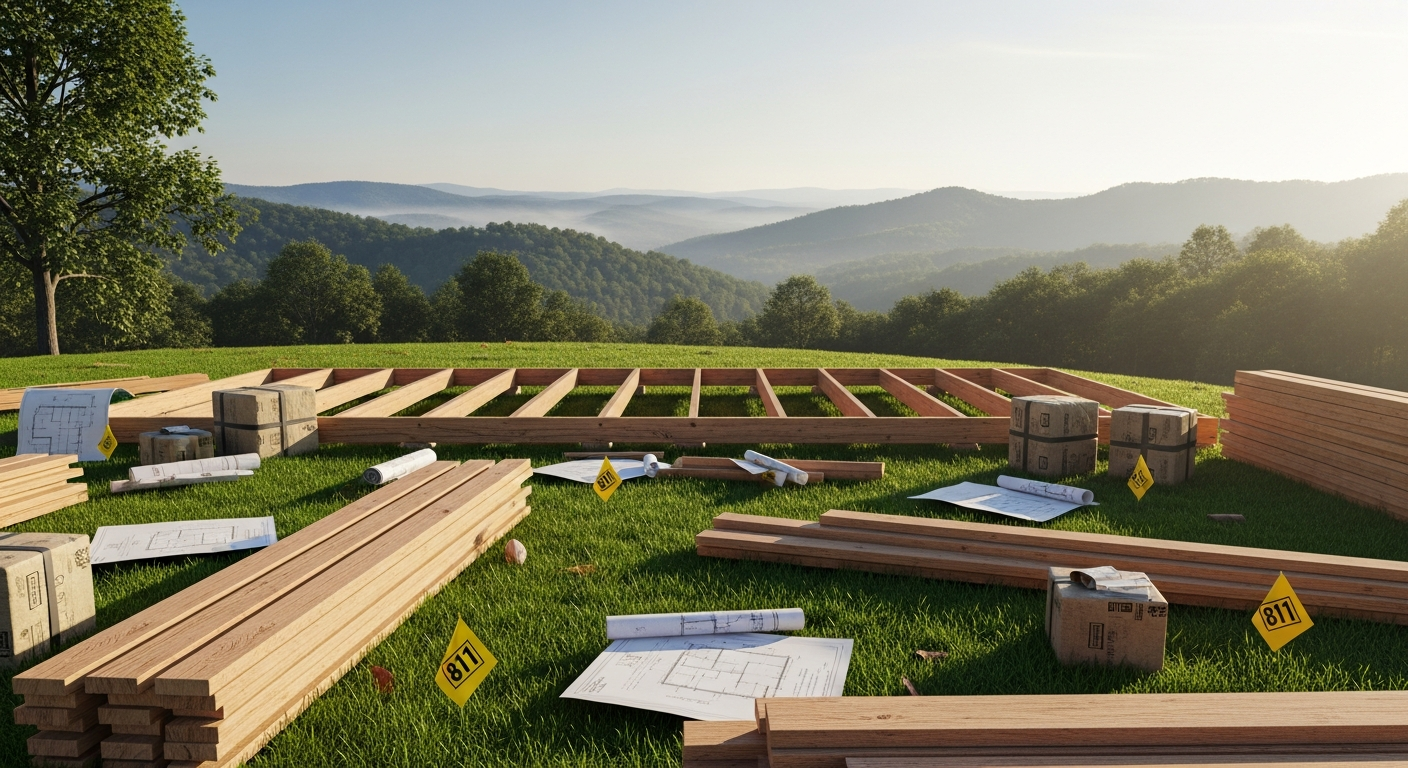
Spring is almost upon us, and with it comes a renewed interest in the "great outdoors"—specifically the patch of land around my house. After my sister and I got my wife two apple trees for her birthday (a Jonathan and a Golden Delicious, the "parents" of the Jonagold apples I wanted to use for her favorite, Dutch apple pie), we got them in the ground. Naturally, that sparked the next project: a place to sit, drink, and eat while watching the trees grow.
Because our garden is mostly grass and slightly sloped, I sat down at my computer to design a level wooden deck. I’m not 18 anymore, so my mantra was "work smarter, not harder." I devised a way to build it with minimal digging, feeling quite proud of my efficiency.
Then, I made the mistake of looking up the regulations.
I assumed that since we live in an unincorporated town, there would be almost no restrictions on what I could build. Boy, was I wrong. Beyond the standard safety rules—like needing a railing if the deck is more than two feet off the ground—I ran head-first into a wall of bureaucracy known simply as THE CODE.
In the U.S., "The Code" makes contractors sound like they belong to a secret society. If you want a permit, you don’t just show them what you are building; you have to prove how you are connecting every single piece of wood. You have to specify the exact bolt types, the size of the beams, the spacing of the joists, and the method of attachment. The most feared line coming out of an inspector is: "It's not according to code."
I thought the Netherlands was the land of over-regulation, but the Dutch are remarkably practical by comparison. Here in the "Land of the Free," they tell you exactly how many inches from the edge of a beam you can drill a hole for a wire, or precisely how to stagger your screws when attaching a joint. I finally found the official code website; imagine Wikipedia, but ten times larger and completely incomprehensible to the layman.
My three hours of designing quickly ballooned into thirty. Thankfully, my original plan was structurally sound enough that the material list didn't grow too much, but the documentation did. Now, I have to produce detailed drawings and explanations to take to the permit office and pray it’s enough.
But we aren't there yet. The final step is to make a call—and who you gonna call? 811. 811 is the "call before you dig" line, a free nationwide service. It turns out you need to have the lot surveyed for any type of utility line—water, gas, electricity—even if you're only digging a few inches deep. This is something I obviously never thought of when I was planting those apple trees! If you don't call and you hit something, all the risks and costs fall on you, with the appropriately inflated American price tags to match. To make it even more intense, you have to start digging within 10 days of the survey and be finished within 30, or the whole process resets.
And that’s just the paperwork. Once (or if) the permit is granted and the lot is cleared, I still have to drag thirty 12-foot-long 2x10s up the hill. I’m already in need of a massage just thinking about it, especially since I know a chicken coop and a greenhouse are lurking in my wife's future plans.
Freedom, it seems, requires a lot of heavy lifting—and a very specific type of bolt.