
The Dunglish Man
It’s a well-known fact that most Dutch people are somewhat multilingual. Between Dutch, English, German, and a bit of French (plus Frisian for the dedicated), we’re used to switching gears. English is mandatory in our schools, but we really learn it from TV, gaming, and international business. So, when I moved to West Virginia, I figured I was well-prepared.
But there’s a massive difference between understanding English and speaking it in the heart of the Appalachians.
Most Dutch people actually speak a hybrid language officially known as "Dunglish." It’s a mix of English words, Dutch grammar, and directly translated proverbs. To put it in numbers: an American dictionary has about 600,000 words, while a Dutch one has 250,000. However, the average American only uses about 7,500 words in their entire life, while the average Dutch person uses about 5,000.
As an Appalachian by choice, I know about 15,000 English words, but I only use about 3,500 of them. That’s less than half of what the locals use. To bridge that gap, I find myself making Dutch words "sound" English—often with hilarious or embarrassing results. For instance, I might say something is on the "backside" instead of on the back, because the literal Dutch translation is achterkant. I don't always realize that to an American, I’m talking about someone's rear end!
Then there’s the "Queen’s English" problem. In the Netherlands, we are taught Oxford English. This led to a near-confrontation recently when a man asked if he could take a chair that was reserved for my wife. I replied with a very British, very crisp, "No, you can’t." He looked at me like he wanted to punch me in the face. It took me a second to realize that the Oxford pronunciation of "can't" sounds remarkably like a very offensive four-letter American slur.
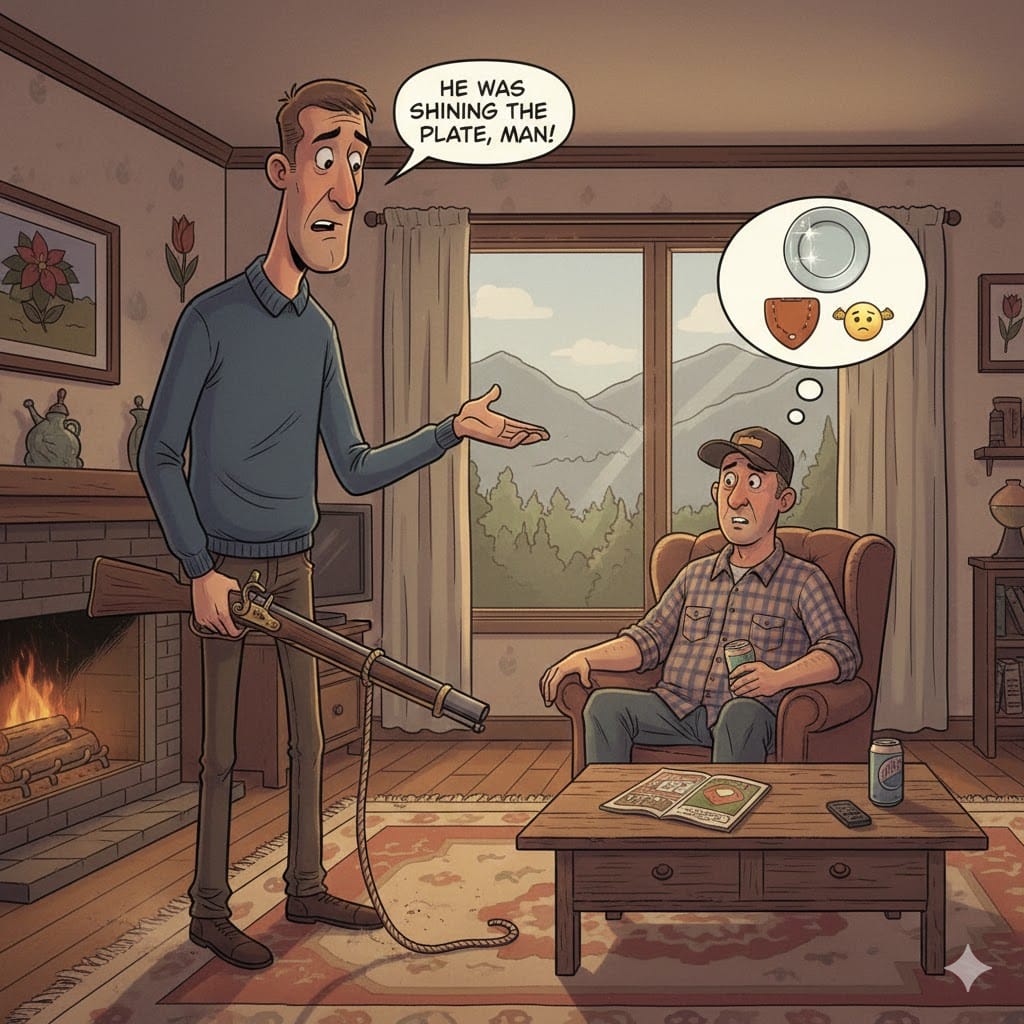
The biggest hurdle, though, is the proverbs. The Dutch have a massive collection of wisdom originating from shipping, farming, and the Bible. We love to translate them literally and watch Americans look at us in total bewilderment. If I tell you someone is "shining the plate," you might think of baseball or chores. In reality, I’m telling you they sneakily retreated—the "plate" being the lockplate of an old musket dragged behind a fleeing soldier.
I’m currently in a second phase of learning. My school English didn’t cover the specific names for kitchen utensils, construction tools, or car parts. Thankfully, the language barrier in West Virginia is made of soft wood, not Dutch concrete. Most people here are more than willing to help me find the right word when I’m stuck in the middle of a "Dunglish" sentence.
Thankfully, my wife is starting to understand some of the Dutch words I use. She’s even learning that the same word with a different emphasis can mean something entirely different. For example, "goedemorgen" is a simple "good morning," but a loud, stressed "GOEDEmorgen" means "Wow, that is an amazing sight!"
I’m getting there, one word at a time—just as long as I remember to watch my pronunciation of "can't!"