
The stud finder Man
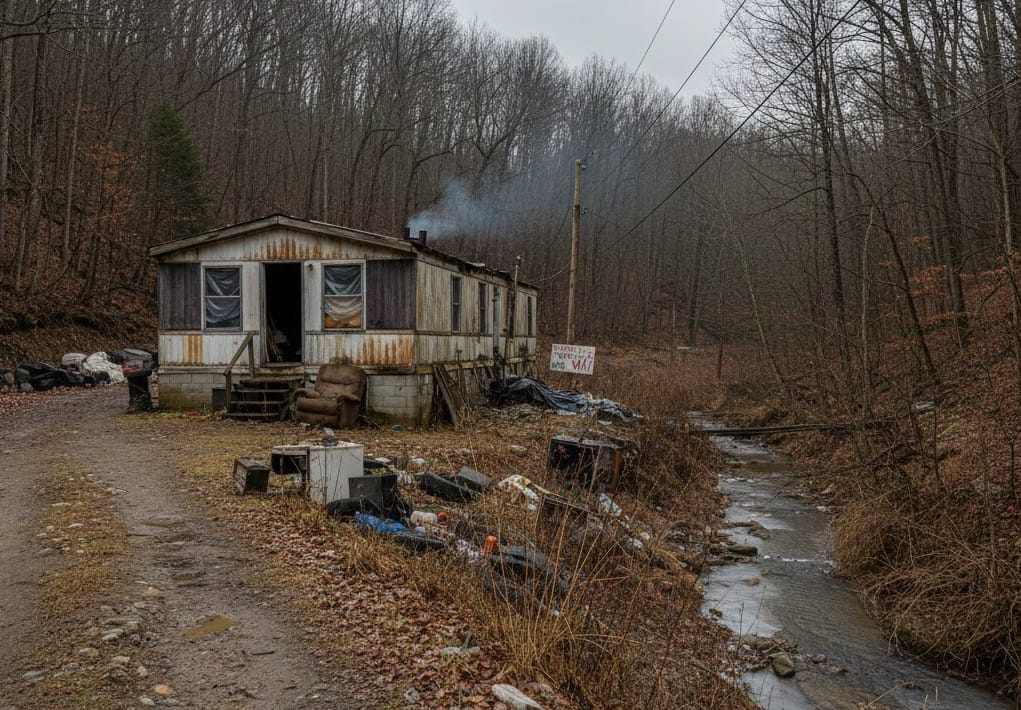
One of the biggest adjustments to living in West Virginia isn't just the food or the landscape—it’s the house itself. Specifically, how it’s built. Coming from the Netherlands, where houses are basically concrete fortresses with thick brick walls and cavity insulation and conduits for all wires, an American home can feel a bit like a mystery.
When we were house hunting, I got a crash course in American construction. You have the "Manufactured Home" (which everyone still calls a Mobile Home, even though they’ve been built to much higher standards since 1976). Then you have the "Log and Timber" homes—think Grizzly Adams—which can range from a tiny mountain cabin to a multi-million dollar luxury lodge.
The most common, however, is "Stick-built." It’s a wooden skeleton covered in siding. It’s flexible, great for building on the steep Appalachian slopes, and incredibly easy to remodel. Then you have "Masonry," but even that is often a trick; it’s usually just a "veneer"—slices of stone half an inch thick glued to the front to give it that heavy look.
One thing that still makes me wonder why is the "neighborhood mix." In the Netherlands, neighborhoods are usually uniform. Here, you can drive past a gorgeous, custom-built luxury estate, and right next door is a rundown 1970s trailer that seems to be defying gravity, surrounded by five rusted cars. And next to that is a manufactured home that looks like it was delivered yesterday. It’s the ultimate American "choose your own adventure" in real estate.
But for a Dutch immigrant, the real "headscratcher" is the interior. In a concrete house, if you want to hang a heavy TV, you grab a pneumatic drill and some heavy-duty bolts. Here, the walls are hollow. My Dutch mind kept asking: How do you hang anything? How do you run wires without PVC conduits? What happens if someone trips and falls through the wall?
The locals just smile and hand you a stud finder. I’ve learned that finding a "stud" (the vertical wooden beams) is like finding gold. If you find the wood, you can screw anything into it. If you miss the wood, you’re relying on "drywall plugs," which I will never truly trust, no matter how much the guy at the hardware store promises they’ll hold.
The upside? You can change anything. If you want a new wall, you just grab some 2x4s and drywall. If you have a leak, you just rip a hole in the wall, fix the pipe, and patch it up. It’s messy, but surprisingly doable for a DIY-er.
Even the roof was a learning curve. In the Netherlands, we use pantiles that last forever. Here, it’s mostly shingles (staggered pieces of asphalt) or metal roofing. Our house came with a beautiful red metal roof, which should outlast any shingle roof in these mountain storms.
I’m also still figuring out my outdoor space. We have a porch, a patio, and a massive concrete slab. I’m not entirely sure which is which yet, but I know I like sitting on them and enjoy the serenity of living in the hills.
I’ve traded my heavy pneumatic drill for an impact driver—a tool I’d never even seen back home but now use for everything. I’m slowly expanding my toolset, learning the new names for every screw and bracket, and slowly accepting that even if my walls are made of wood and paper, they’re still standing.