What's with that Ice, Man
Spring is here, and West Virginia is living up to its reputation as the "Mountain State" by turning every imaginable shade of green.
The transformation is staggering. Last year, when my family visited from the Netherlands, they witnessed the landscape shift from a brown, leafless dormancy to a lush, 50-shades-of-green masterpiece in just three weeks. While Washington claims the title of the "Evergreen State," I’d argue West Virginia beats it. Sure, Washington has its conifers, but it lacks the sheer variety of hardwoods that explode with color. I know other states might have more total trees, but as the West Virginia Man, I’m allowed a little bias! But to understand this greenness, you have to look back at the winter.
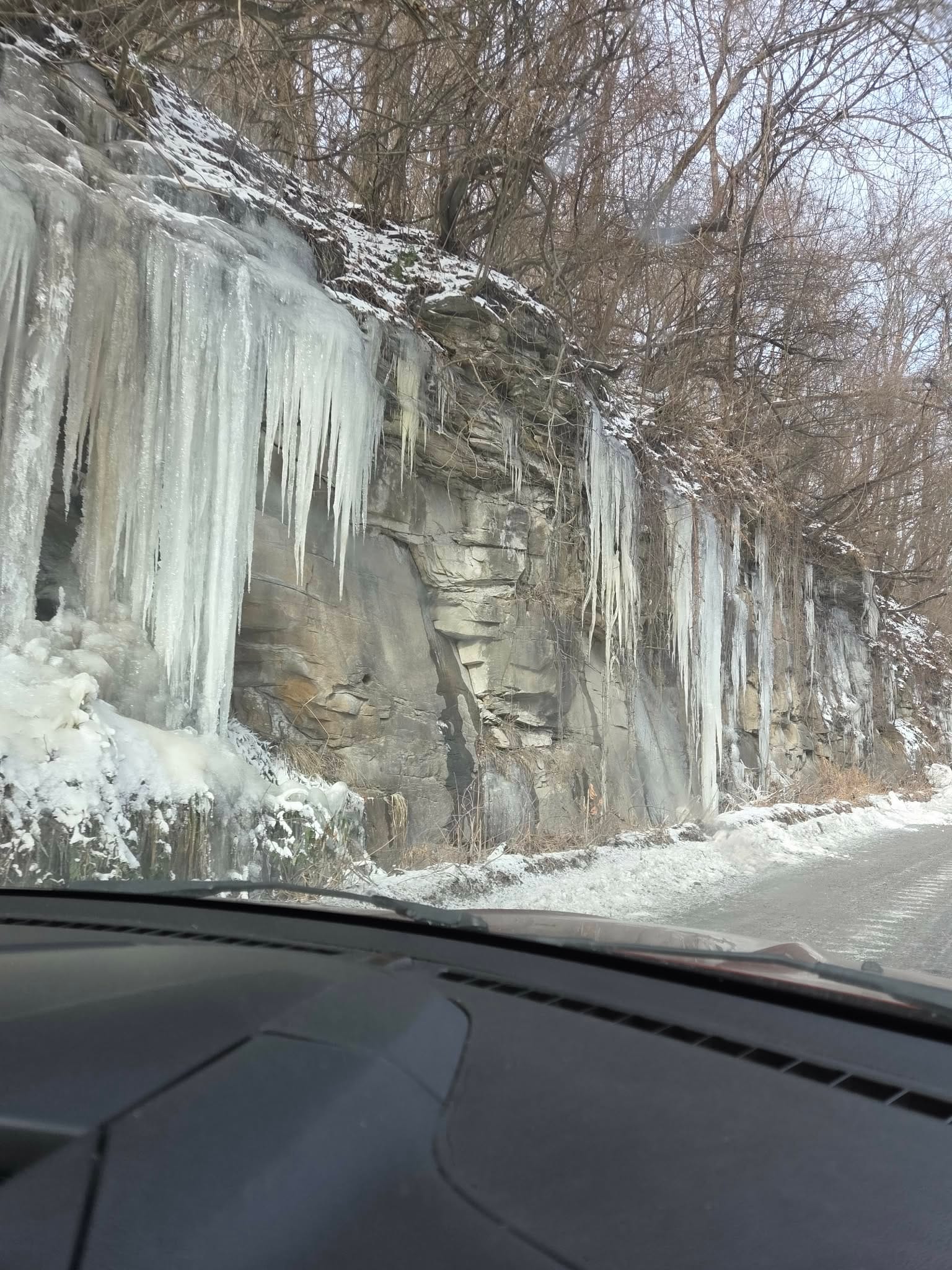
As I’ve mentioned, the weather here is unpredictable—six inches of snow one day, searing heat the next. During the cold snaps, I noticed something I had never seen in places like Austria or Switzerland: "Ice Walls." These aren’t just frozen creeks or waterfalls; they are long stretches of the mountainside covered in massive icicles that seem to emerge directly out of the solid rock. I didn't give it much thought at the time, but a few weeks ago, the mystery solved itself.
The temperature had climbed well beyond 80°F (around 27°C for my Dutch readers). Our house sits on a flat "shelf" on the mountainside. Behind us, the mountain rises up—though, if I’m being honest, they look more like big hills than the Alps. On this hot day, long after the rain had stopped and the local creeks had receded, I heard the sound of running water. I looked up and saw water seeping directly out of the rock face. It wasn't a stream flowing over the top; it was coming from inside.
I started researching and discovered that West Virginia’s mountains are like a giant layered cake. They are made of alternating layers of hard rock and softer, porous material. When it rains, the water seeps deep into the mountain’s "soft" layers. When it hits a "hard" layer, it can’t go down anymore, so it moves sideways until it hits the edge of the mountain and leaks out.
This explains the ice walls. When the roads were blasted through the mountains, the engineers cut vertically through these layers. In the winter, that hidden, seeping water freezes the moment it touches the air, creating those massive frozen curtains. This internal "plumbing" system is also why the state is so incredibly fertile. The mountains are essentially giant sponges, slowly feeding water to everything that grows.
However, having that many trees has a downside: they eventually fall over. Wherever you drive, you see sawed-off trunks that fell across the road, or trees still hanging in the powerlines as if testing the strength of the wires. On every hillside, you see them lying head-down, held in place only by their neighbors. We even woke up one day to find a tree spanning the full width of our yard. Now, we keep a sharp eye on the trees above our house—preventive lumberjacking might be in my near future.
But the upside of all this timber is the view. My son pointed out something I hadn't fully realized: the lack of overhead road signs. In the Netherlands, highways are cluttered with signals and signs hanging over the lanes. Here, once you leave the big interchanges, the view is unobstructed. Driving through these winding roads and green forests is the best way to wind down and relax—which is a good thing, considering the massive distances we have to drive just to get anywhere!